-
Key Reasons Why Overpressure Protection Matters in Hydraulic Pumps
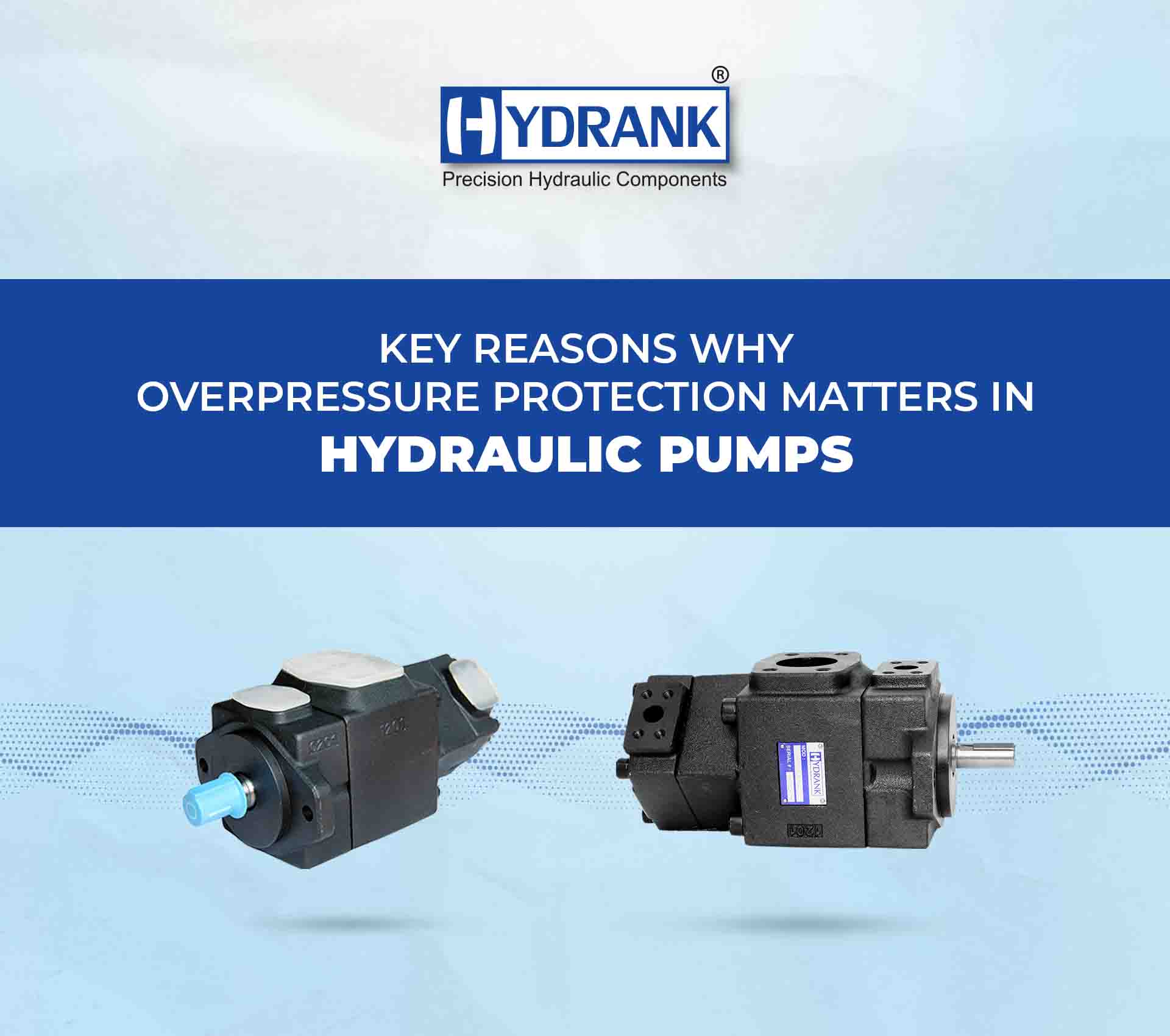
Hydraulic systems rely on pressure to do their job. It’s what enables compact components to lift heavy loads, control motion precisely, and deliver consistent performance. At the same time, pressure is also the quickest way to damage a system when it isn’t properly managed.
One important thing to remember is that hydraulic pumps do not control pressure. They generate flow. If resistance increases and the oil has nowhere to go, pressure rises immediately. This isn’t a flaw in design it’s the basic nature of hydraulics. Overpressure protection exists to manage this reality before damage occurs, not after a failure has already happened.
How Overpressure Develops in Real Operating Conditions?
Overpressure doesn’t require a dramatic breakdown or an obvious fault. In most A hydraulic systems, it develops during everyday operation.
A cylinder reaches the end of its stroke while flow continues. A directional valve shifts under load. A filter becomes partially clogged. Cold starts change oil viscosity. Each of these situations increases resistance suddenly.
Because hydraulic oil is incompressible, pressure spikes instantly. Without a pressure-limiting path, that spike continues to build until a component reaches its mechanical limit. When that happens, the system doesn’t degrade slowly; it fails abruptly.
Why Pumps Are Usually the First Components to Fail?
Pumps are exposed to system pressure at all times. When pressure exceeds design limits, the pump absorbs the stress long before other components show visible signs of trouble.
Damage typically starts internally. Bearings carry loads they were never designed for. Shafts flex. Seals deform. Internal leakage increases, creating heat and circulating contamination. Once contamination enters the system, valves and actuators are affected soon after.
This is why pump damage prevention is one of the primary reasons overpressure protection matters. When a pump fails, it rarely fails in isolation—the effects spread quickly throughout the system.
Overpressure Is Also a Safety Concern
Excess pressure doesn’t just shorten equipment life; it creates serious safety risks.
A hose or fitting that fails under high pressure does so without warning. Escaping hydraulic oil can cause severe injury, destabilize machinery, or create fire hazards near hot surfaces. These incidents don’t wait for scheduled maintenance or visible warning signs.
Overpressure protection establishes a clear pressure ceiling. No matter what happens downstream, pressure cannot exceed safe system limits. From a safety standpoint, that boundary is essential.
Pressure Control Keeps Systems Predictable
Hydraulic systems are expected to behave consistently, even when loads vary. Without a defined pressure limit, system behavior becomes unpredictable.
Actuators may stall, surge, or overshoot. Pressure oscillations increase mechanical stress. Cycle times drift. Over time, this unpredictability shortens component life and complicates operation.
Effective pressure control stabilizes system response. It allows the system to absorb unexpected conditions without turning them into damage or instability.
Why Relief Valves Play a Unique Role?
Many components influence pressure during normal operation; load-sensing circuits, pressure-reducing valves, and sequencing logic all have their place. These work well as long as the system behaves as expected.
Relief valves serve a different purpose. They respond automatically when pressure exceeds safe limits, regardless of the cause. They don’t rely on electronics, sensors, or operator input. They react purely to pressure.
That makes them the final safeguard when operating conditions move outside the normal range.
Common Reasons Overpressure Protection Falls Short
In many systems, protection exists but doesn’t work as intended.
Relief valves may be set too high to avoid nuisance dumping. Valves may be undersized for the pump’s flow. Contamination can restrict movement. Poor installation locations can delay pressure relief.
On paper, the system looks protected. In practice, pressure still reaches damaging levels. Effective overpressure protection depends on correct sizing, proper placement, and realistic pressure settings.
The Connection Between Overpressure and Heat
Excess pressure always turns into heat. When a system continuously relieves pressure instead of operating within proper limits, oil temperature rises.
As the temperature increases, the viscosity drops. Lubrication suffers. Seals age faster. Fluid oxidizes. What appears to be a cooling issue is often a pressure control problem at its core.
By limiting unnecessary pressure buildup, overpressure protection helps maintain stable operating temperatures and preserves fluid quality.
Designing Systems with Pump Protection in Mind
Hydraulic systems that perform reliably over time are usually designed with pressure control as a priority.
This means relief valves sized for full pump flow, pressure settings matched to pump ratings, secondary protection in critical circuits, and regular inspection rather than “set-and-forget” assumptions.
When overpressure protection is treated as a core design element, pump life increases and overall system reliability improves.
Why Pressure Control Is Central to Shriank’s Approach?
At Shriank, pressure management is not an afterthought. Overpressure protection is considered alongside pump selection, duty cycle, and operating environment.
By integrating proper pressure control into system design, Shriank helps ensure hydraulic systems operate safely, predictably, and with minimal risk of sudden failure, whether in industrial machinery or mobile applications.
Conclusion: Pressure Control Protects Everything Downstream
Overpressure doesn’t announce itself. When it occurs, damage follows quickly, and the pump is often the first casualty.
Effective overpressure protection limits pressure before it becomes destructive. It protects pumps, stabilizes system behavior, and reduces safety risks. In hydraulic engineering, it is not a secondary feature, it is the foundation.
Every hydraulic pump operates on the assumption that pressure will be controlled.
When that assumption holds, systems perform reliably.
When it doesn’t, failure is inevitable.That’s why overpressure protection remains one of the most critical requirements in any hydraulic system designed to last.
India's Largest Hydraulic Vane Pump Supplier
contact us: +91 98980 09148

Subscribe to E-Mail Newsletters and Alerts
 submit

Delivery
Prompt and accurate delivery

Client Servicing
Pro after-sales customer support

Quality assurance
Top quality standards

Export
More then 10 countries