-
Why Every Hydraulic System Needs a Pressure Relief Valve
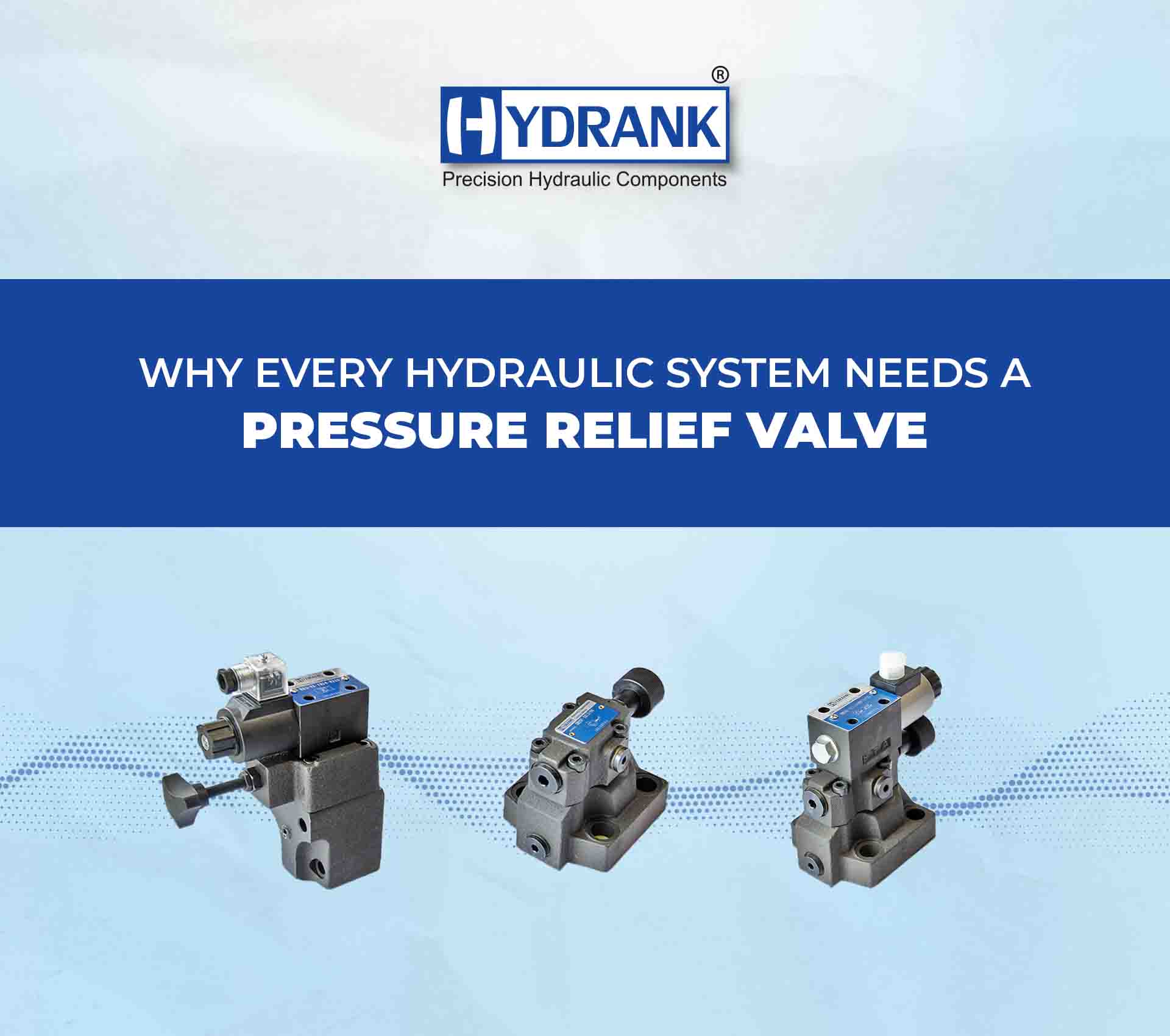
Anyone with experience in hydraulic machinery has seen the consequences of uncontrolled pressure. A system may operate smoothly for months, only for a single stalled actuator or blocked line to crack a pump housing, burst a hose, or destroy seals throughout the circuit. In most such cases, the cause is the same: pressure had nowhere to escape.
This is why pressure relief valves exist—not as optional safety accessories, but as fundamental components of any hydraulic system expected to operate reliably. Pressure gives hydraulics their power. At the same time, it makes them unforgiving when not properly controlled.
Pressure Does Not Regulate Itself in Hydraulic Systems
Unlike electrical systems, hydraulic systems do not naturally limit pressure. Hydraulic oil is essentially incompressible. When resistance increases, pressure rises immediately and continues to rise as long as the pump delivers flow.
This situation occurs more frequently than many assume:
- A directional valve shifts against a closed load
- A cylinder reaches the end of its stroke while flow continues
- A line becomes restricted due to contamination
- A load suddenly exceeds normal operating limits
In all these cases, the pump continues to push fluid. Without a defined pressure ceiling, the system will exceed the mechanical strength of its weakest component. This is where the pressure relief valve becomes critical, not in theory, but in real operating conditions.
What a Pressure Relief Valve Actually Does?
A pressure relief valve When system pressure reaches a preset limit, the valve opens and diverts excess oil back to the tank or a low-pressure return path. Pressure stops rising, and components are protected.
There are no electronics or sensors involved, just a mechanical response to pressure. When correctly selected and set, a relief valve:
- Limits maximum system pressure
- Prevents pump overload
- Protects hoses, valves, and actuators
- Keeps the system within its design limits
A relief valve does not control motion. It controls damage.
Pump Protection Is the Primary Reason Relief Valves Matter
Hydraulic pumps are not designed to stall against unlimited pressure. Even brief overpressure events place extreme stress on internal components such as bearings, shafts, seals, and pressure plates.
Without a relief valve:
- Internal leakage increases rapidly, generating heat
- Seals deform or extrude
- Bearings overload
- Pressure imbalances can lead to cavitation
Once pump damage begins, it rarely remains isolated. Contamination spreads through the system, accelerating wear in valves, cylinders, and actuators. In real-world service conditions, pump failure without overpressure protection is usually sudden and costly, not gradual.
Overpressure Is a Safety Issue, Not Just a Maintenance Issue
Hydraulic oil escaping under pressure presents serious safety risks. Hose or fitting failures occur without warning and can result in:
- Fluid injection injuries
- Equipment instability
- Fire hazards near hot surfaces
A properly functioning relief valve prevents pressure from reaching these dangerous levels. It protects equipment, but more importantly, it protects the people working around the system. For this reason alone, overpressure protection is non-negotiable.
Relief Valves Stabilize System Behavior
Beyond safety, pressure relief valves play a key role in system stability. Hydraulic loads are rarely constant. When loads change suddenly, pressure fluctuates.
Without an upper pressure boundary, these fluctuations can lead to:
- Jerky or inconsistent actuator motion
- Pressure oscillations
- Increased mechanical fatigue
By limiting peak pressure, the relief valve helps keep system response predictable. This improves control accuracy and extends component life.
Why Relief Valves Are Different from Other Control Valves?
Pressure relief valves are often confused with other hydraulic control valves, but their functions are distinct.
A pressure-reducing valve controls pressure in a specific branch circuit. A sequence valve controls the order of actuator movement.
A flow control valve regulates speed, not pressure.Only the pressure relief valve is designed to protect the entire system from overpressure—including situations the original designer may not have anticipated.
Placement Matters More Than Many Realize
Relief valves must be installed where pressure builds first, typically:
- At the pump outlet
- On pump-mounted manifolds
- In main pressure lines
- As secondary protection in critical circuits
Incorrect placement can delay pressure release, allowing damage to occur before the valve reacts. Proper location ensures excess pressure is relieved before it reaches sensitive components.
What Happens When a System Operates Without a Relief Valve?
Systems without relief valves do not fail randomly; they fail predictably:
- Pumps overheat
- Seals fail
- Hoses rupture
- Cylinders suffer internal damage
- Downtime escalates rapidly
In extreme cases, failure occurs the first time the system deadheads. This is why modern hydraulic design standards treat relief valves as mandatory components.
Different Systems Require Different Relief Valves
Direct-acting relief valves respond quickly and are well-suited for smaller systems. Pilot-operated relief valves provide greater stability at higher flow rates and are commonly used in industrial applications.
The correct choice depends on:
- Flow capacity
- Pressure range
- Required response time
- System complexity
Selecting the wrong type does not merely reduce performance—it compromises protection.
Correct Setting Is Just as Important as Selection
A relief valve that is set incorrectly can create problems of its own.
If set too low, it continuously dumps pressure, generating excess heat.
If set too high, it fails to protect the system.Best practice is to set the valve slightly above normal operating pressure and verify its behavior under actual load conditions. Periodic inspection and recalibration are essential, particularly in high-duty systems.
Why Pressure Control Is Central to Shriank’s Design Philosophy?
A Shriank , pressure control is treated as a core system requirement, not an afterthought. Relief valves are selected and integrated based on real operating conditions, including pump output, duty cycle, and circuit behavior.
By prioritizing accurate pressure control, Shriank ensures hydraulic systems operate safely, efficiently, and predictably across both industrial and mobile applications.
Conclusion: Pressure Control Is the Foundation of Reliable Hydraulics
Every hydraulic system needs a defined pressure ceiling. Without it, performance becomes unpredictable, and failure is inevitable.
A pressure relief valve does not increase speed or output. Its role is far more critical: preventing damage, stabilizing operation, and protecting both equipment and personnel. In hydraulic engineering, it is one of the most important components in the system, even though it operates quietly in the background.
Control the pressure, and the system performs as designed.
Ignore it, and failure is only a matter of time.
India's Largest Hydraulic Vane Pump Supplier
contact us: +91 98980 09148

Subscribe to E-Mail Newsletters and Alerts
 submit

Delivery
Prompt and accurate delivery

Client Servicing
Pro after-sales customer support

Quality assurance
Top quality standards

Export
More then 10 countries