-
Pressure vs Flow Control in Hydraulic Proportional Valves: What’s the Difference?
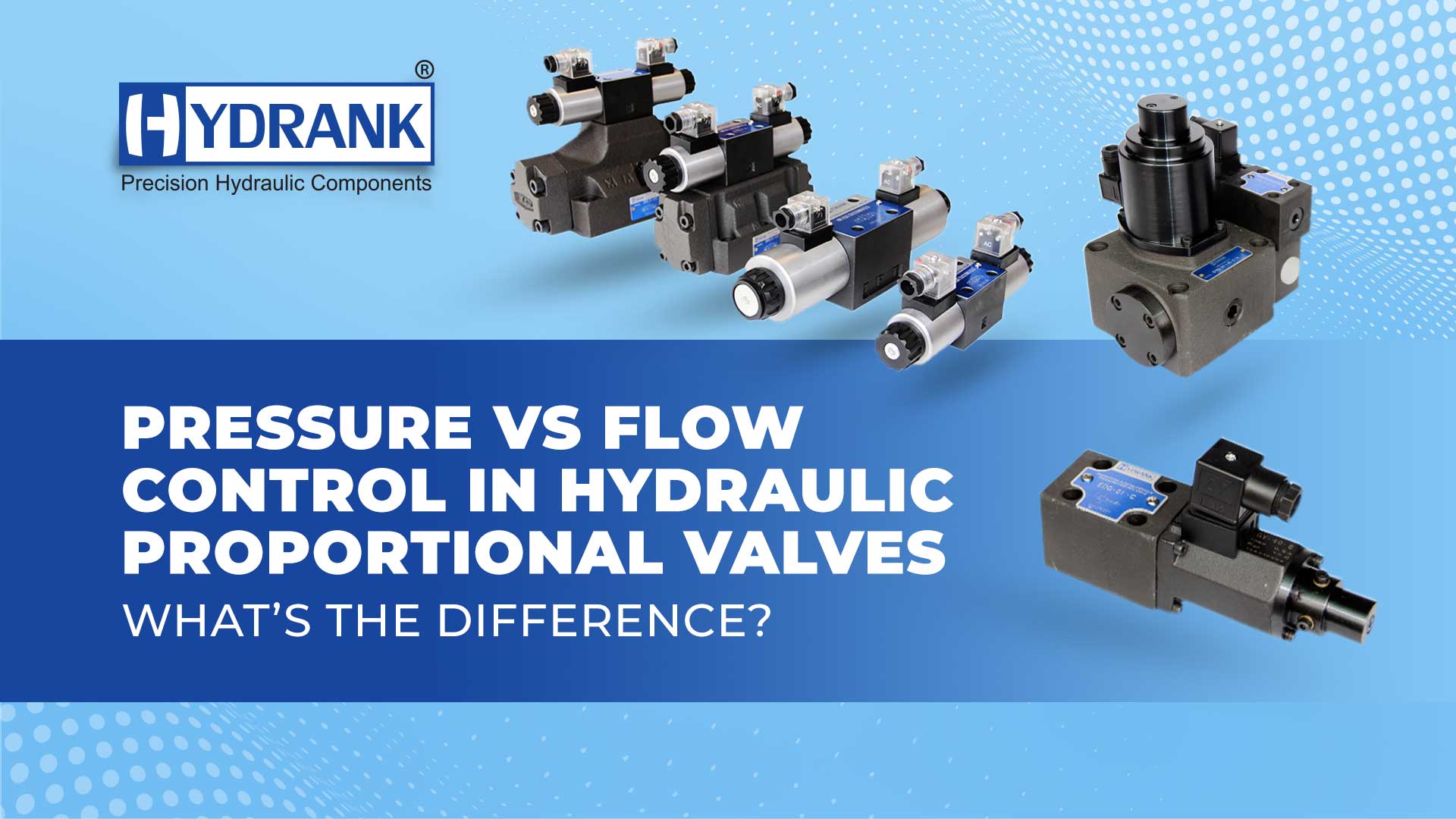
Modern hydraulic systems require more than simple on-and-off control. Industrial machinery often needs precise adjustments in force, speed, acceleration, and movement depending on the stage of operation. This is where hydraulic proportional valves play an important role.
Proportional valves allow hydraulic parameters to be adjusted progressively according to an electrical input signal. Two of their most important functions are pressure control and flow control. Although these functions are closely related within a hydraulic circuit, they serve different purposes.
Understanding pressure vs. flow control helps maintenance teams, engineers, and machine operators select the right valve and diagnose hydraulic performance issues more accurately.
What Are Hydraulic Proportional Valves?
Traditional hydraulic valves may operate between fixed positions, such as open and closed. A proportional hydraulic valve, on the other hand, can provide variable output based on the electrical signal it receives.
As the input signal changes, the valve adjusts accordingly, enabling more precise control over hydraulic pressure, flow, or direction.
This makes proportional technology valuable in applications where machines need smooth transitions rather than abrupt changes. Examples include hydraulic presses, injection molding machines, material-handling equipment, machine tools, and automated production systems.
Depending on the application, a system may use a proportional pressure valve, a proportional flow valve, or multiple valves to manage different functions.
What Is Hydraulic Pressure Control?
Pressure in a hydraulic system is closely associated with the force or torque available to perform work. Hydraulic pressure control is therefore important when a machine needs to regulate or limit the amount of force generated.
A pressure control valve manages system pressure according to the requirements of the hydraulic circuit. With proportional control, pressure can be varied rather than being limited to a single fixed setting.
For example, a hydraulic press may require relatively low pressure while positioning a component but substantially higher pressure during the pressing operation. A proportional pressure valve allows the system to make this transition smoothly according to the control signal.
Pressure control is commonly useful when:
- Different stages of operation require different force levels
- Maximum system pressure needs to be controlled
- Smooth force transitions are important
- Sensitive components need protection from excessive pressure
- Repeatable force is required during production
Correct pressure control can contribute to more consistent machine operation while reducing unnecessary stress on hydraulic components.
What Is Hydraulic Flow Control?
While pressure primarily relates to force, hydraulic flow primarily influences how quickly an actuator moves.
A flow control valve regulates the volume of hydraulic fluid travelling through a particular part of the circuit. When proportional technology is used, the flow can be continuously adjusted according to the electrical command signal.
A proportional flow control valve can therefore provide precise control over cylinder or hydraulic motor speed.
Increasing the available flow generally increases actuator speed, while reducing the flow slows movement. This makes hydraulic flow control important in applications where machinery requires controlled acceleration, deceleration, positioning, or different operating speeds.
Typical applications include variable cylinder movement, conveyor systems, hydraulic motors, material-handling equipment, machine tools, and automated manufacturing machinery.
Pressure vs. Flow Control: What’s the Difference?
The simplest way to understand pressure vs flow control is to consider what each parameter primarily influences.
Factor Pressure Control Flow Control Primary function Regulates hydraulic pressure Regulates hydraulic fluid flow Mainly influences Force or torque Actuator speed Typical valve Pressure control valve Flow control valve Proportional option Proportional pressure valve Proportional flow control valve Common applications Pressing, clamping, force limiting Speed, movement, and motion control Although they perform different functions, pressure and flow are interconnected within a hydraulic system. Changes in load, resistance,
pump output, valve position, and actuator requirements can influence overall circuit behavior.
For this reason, pressure and flow should be considered as parts of the complete hydraulic system rather than isolated parameters.
When Should You Use a Proportional Pressure Valve?
A proportional pressure valve is generally suitable when the primary requirement is adjustable force or pressure.
Consider a machine that performs several operations during one production cycle. One stage may require gentle clamping, while another needs significantly greater force. Instead of operating at maximum pressure throughout the entire cycle, proportional pressure control allows pressure to be adjusted according to each stage.
This can provide smoother machine operation and greater control over processes where excessive force could affect components or finished products.
When Should You Use a Proportional Flow Control Valve?
A proportional flow control valve is more appropriate when precise control of actuator speed or movement is the priority.
For example, a hydraulic cylinder may need to move rapidly during an initial approach, slow down when reaching the workpiece, and then return at a different speed. Proportional flow control allows these speed changes to occur smoothly.
This capability is particularly useful in automated machinery where repeatable motion profiles and controlled transitions contribute to consistent operation.
Can a Hydraulic System Require Both?
Yes. Many industrial hydraulic systems require both hydraulic pressure control and hydraulic flow control.
A machine may need to control how quickly an actuator moves while also limiting or adjusting the force it produces. In these cases, pressure and flow control functions work together to achieve the required machine performance.
Selecting the appropriate hydraulic proportional valves therefore depends on factors such as operating pressure, required flow, actuator characteristics, duty cycle, control signals, response requirements, and the overall hydraulic circuit design.
Shriank Solutions for Hydraulic Proportional Valves
Selecting the correct proportional valve requires more than choosing between pressure and flow control. The valve must also be compatible with the operating conditions and control requirements of the application.
Shriank provides hydraulic solutions and technical support for industrial applications, helping businesses identify components according to their system requirements.
Whether an application requires a pressure control valve, flow control valve, proportional pressure valve, or proportional flow control valve, evaluating the complete hydraulic circuit helps ensure that the selected solution matches the machine’s intended operation.
Conclusion
The fundamental difference between pressure and flow control lies in what they regulate. Pressure control primarily manages force or torque, while flow control primarily manages actuator speed.
With hydraulic proportional valves, both parameters can be adjusted progressively according to machine requirements, enabling smoother and more precise hydraulic operation.
Understanding the role of each valve—and considering pressure, flow, actuators, control signals, and overall circuit requirements together—helps businesses select the appropriate proportional hydraulic solution for reliable industrial performance.
India's Largest Hydraulic Vane Pump Supplier
contact us: +91 98980 09148

Subscribe to E-Mail Newsletters and Alerts
 submit

Delivery
Prompt and accurate delivery

Client Servicing
Pro after-sales customer support

Quality assurance
Top quality standards

Export
More then 10 countries